Ask any small business owner in Houston how their week is going, and IT problems come up more often than you’d expect. A server that won’t reboot before a Monday morning client call. An employee who clicked the wrong link and now half the office can’t access shared files. A vendor invoice that got delayed because the accounting software crashed overnight. None of these are catastrophic on their own, but stacked together, they eat hours that a growing company can’t spare. That’s the gap managed IT services in Houston are built to close — not by promising a perfect, problem-free network, but by making sure someone is actually watching before small issues turn into expensive ones.
What “Managed IT” Actually Means
The term gets thrown around loosely, so it’s worth being specific. A managed IT provider takes over the day-to-day responsibility for keeping a company’s technology running — monitoring servers and workstations, patching software before vulnerabilities get exploited, managing backups, fielding help desk tickets, and planning for growth instead of just reacting to breakdowns. It’s the difference between calling a repair technician after the roof leaks and having someone check the shingles every season.
For a lot of Houston companies, especially those without a dedicated in-house IT department, this shift changes the whole rhythm of the business. Instead of an owner or office manager troubleshooting printer drivers between actual work, a managed provider handles it in the background, usually before anyone notices there was a problem at all.
Why Houston’s Business Environment Makes This Especially Relevant
Houston isn’t a one-industry town, and that variety changes what companies need from their technology. A law firm downtown has different compliance concerns than a manufacturing operation near the Ship Channel, and a healthcare clinic in the Medical Center has entirely different obligations around patient data than either of them. Managed IT providers who work across this kind of mixed economy tend to understand nuance that a generic national call center simply doesn’t — what HIPAA actually requires in practice, why an energy company’s field offices need different connectivity than its downtown headquarters, why a retail business cares more about point-of-sale uptime than server redundancy.
Then there’s the weather. Houston companies plan around hurricane season the way businesses in other cities plan around holidays — it’s simply part of the calendar. Power outages, flooding, and sudden office closures aren’t hypothetical risks here; most local business owners have a story about at least one storm that knocked out operations for days. A managed IT provider based in the region tends to build disaster recovery and remote-access planning around that reality from the start, rather than treating it as an edge case.
Where Uprite Fits Into That Picture
Uprite works with Houston businesses that want their technology handled by people who are actually local — not a support queue routed somewhere out of state that has never seen the office layout or knows which building has the finicky internet closet. The appeal for a lot of clients isn’t flashy; it’s more that someone answers the phone quickly, understands the business already, and doesn’t need a lengthy explanation every time something goes wrong.
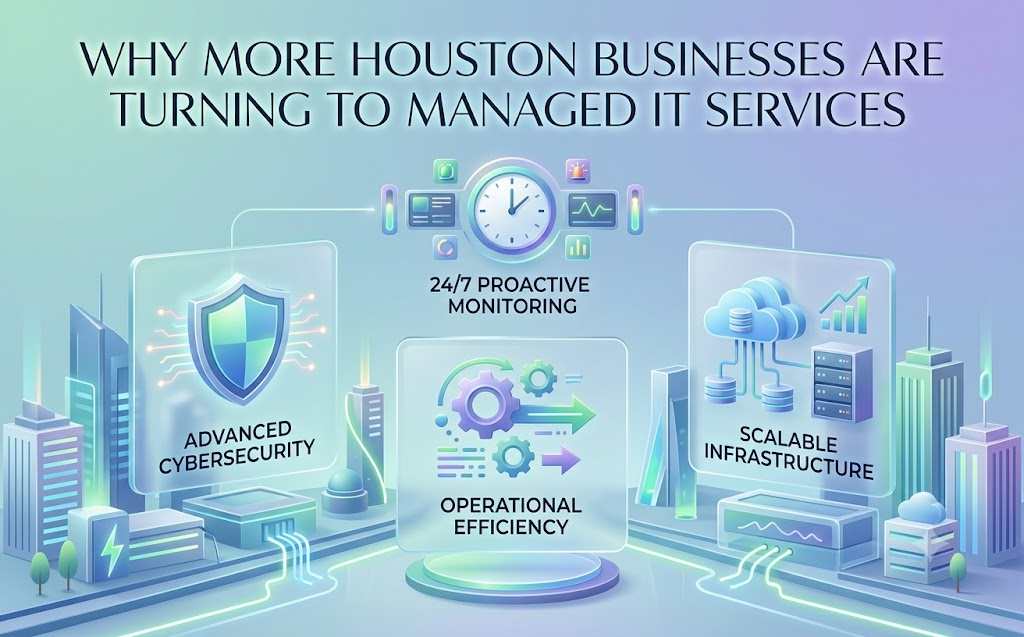
That local grounding matters more than it sounds like on paper. When a storm knocks out power to a business park off the Beltway, or when a client’s office moves from Midtown to the Energy Corridor, a provider who already knows Houston’s infrastructure and business districts can respond faster than one working from a script. Uprite’s approach leans on proactive monitoring and cybersecurity as much as break-fix support, aiming to catch ransomware attempts, failing hardware, or unpatched systems before they turn into downtime.
Signs a Business Has Outgrown Its Current IT Setup
Certain patterns tend to show up before a company realizes it needs help. If the same employee keeps getting pulled away from their actual job to fix computer issues, that’s a sign. If nobody can say with confidence when the last backup ran — or worse, whether it would actually restore anything — that’s a bigger one. Rising cyber insurance premiums, slow software updates, or a general sense that the office network is held together with good intentions are all common triggers for businesses that eventually make the switch to a managed provider.
Growth itself is often the real trigger. A company that hires its tenth or fifteenth employee usually hits a wall where informal IT — someone’s cousin who’s good with computers, or the office manager who happens to know Excel macros — stops being enough. That’s usually when Houston businesses start actively comparing managed IT providers rather than just tolerating whatever setup they inherited.
What to Look for in a Provider
Response time is the obvious one, but it’s worth digging into what a provider actually guarantees versus what they imply. Ask how issues get prioritized, whether there’s a dedicated technician who learns the account or a rotating pool of strangers, and how backups are tested — not just scheduled. Security should come up early in the conversation, not as an upsell after the contract is signed. And since so much business happens across the greater Houston area now, from Sugar Land to The Woodlands, it’s worth asking how remote and hybrid teams are supported, not just a single office location.
The right fit usually shows up less in the sales pitch and more in the follow-up questions a provider asks. A team that wants to understand how the business actually operates — not just what hardware it owns — tends to build a setup that holds up when something unexpected happens, which in Houston, eventually, it will.
The Bottom Line
Technology problems rarely announce themselves in advance. They show up as a Monday morning outage, a missed deadline, or a security incident that could have been caught weeks earlier. For Houston businesses trying to grow without a full internal IT staff, working with a managed provider like Uprite isn’t about chasing the newest software trend — it’s about having someone in the region who already knows the business, answers quickly, and quietly prevents the kind of problems that would otherwise cost a full day.