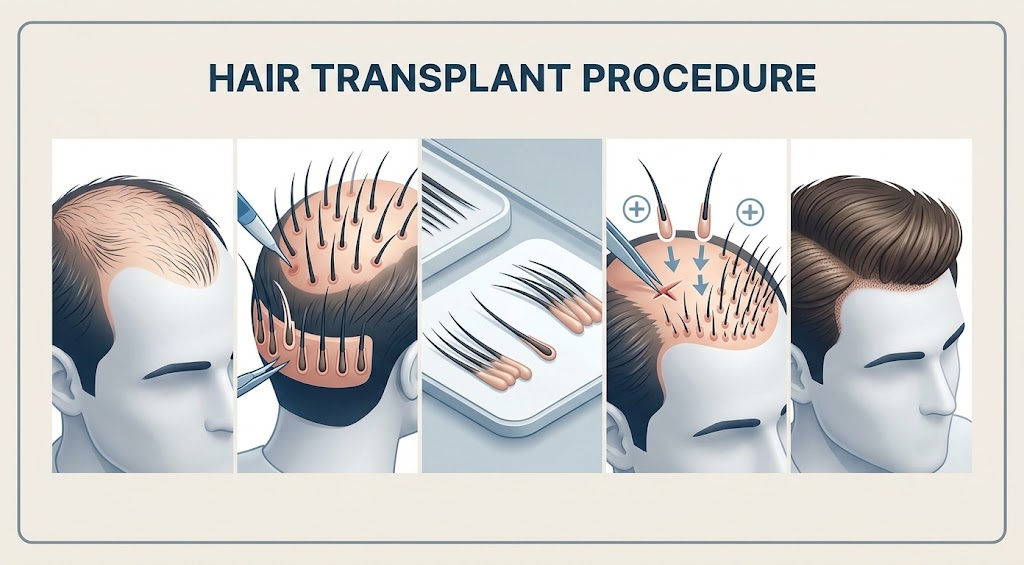
Hair loss can affect appearance, confidence, and the way people feel in social or professional situations. While temporary shedding may improve on its own, progressive thinning and pattern baldness often require a more focused approach. A hair transplant is a surgical procedure that moves healthy hair follicles from one part of the scalp to areas affected by thinning or baldness. Modern techniques aim to create results that blend naturally with existing hair.
What Is a Hair Transplant?
A hair transplant involves taking follicular units from a donor area, usually where hair is more resistant to pattern loss, and placing them into areas with reduced density. The transplanted follicles can continue producing hair after they become established. Because the follicles are moved rather than simply adding artificial strands, the goal is a long-term, natural-looking improvement.
The procedure is generally performed under local anesthesia. A consultation is important because the provider must evaluate the pattern of hair loss, scalp condition, donor density, hair characteristics, age, and expectations. These factors help determine whether transplantation is appropriate and how many grafts may be needed.
Common Hair Transplant Techniques
Follicular Unit Extraction, commonly called FUE, involves removing individual follicular units from the donor region with specialized instruments. These units are then prepared and implanted into carefully planned recipient sites. FUE does not require a long linear incision, and the small extraction marks typically become less noticeable as they heal.
Follicular Unit Transplantation, or FUT, uses a strip of donor scalp that is divided into individual follicular units before implantation. FUT can provide a substantial number of grafts in suitable candidates, but it leaves a linear donor scar. The best technique depends on individual anatomy, hair characteristics, treatment goals, and the clinician’s assessment rather than on marketing claims alone.
How the Procedure Is Planned
Good planning begins with designing the hairline. A skilled practitioner considers facial proportions, existing hair direction, age, and the likely progression of hair loss. A hairline that looks appropriate immediately after surgery should also remain believable as a person ages. Overly low or dense hairlines may consume valuable donor follicles and can appear unnatural later.
The recipient area is then mapped according to density requirements and the direction and angle of existing hair. Graft numbers are estimated based on the available donor supply and the size of the thinning area. Photographs, medical history, medication information, and scalp examination may also be part of the consultation.
What Happens During Recovery?
Immediately after treatment, the scalp may have redness, swelling, tenderness, or small crusts around implanted grafts. These effects vary between individuals and generally improve as healing progresses. Patients are usually given specific instructions about washing, sleeping position, physical activity, and scalp care.
A temporary shedding phase can occur several weeks after transplantation. This can be concerning, but shedding of the visible hair from newly transplanted follicles does not necessarily mean the treatment has failed. The follicles may enter a resting phase before new growth begins. Patience is therefore an important part of the recovery process.
When Do Results Appear?
Hair growth after transplantation takes time. Early changes may be subtle, while visible growth generally develops gradually over several months. Hair can initially appear fine before becoming thicker as the growth cycle progresses. Final results are commonly assessed after sufficient time has passed for the transplanted follicles to mature.
Results vary considerably. Some people achieve noticeable improvement, while others may require more than one procedure to reach their desired density. The available donor supply is limited, so expectations should be based on what can realistically be achieved rather than on heavily edited photographs or promises of guaranteed density.
Benefits of Hair Transplantation
One major advantage is that transplanted follicles can provide growing hair in areas affected by permanent pattern loss. This can improve coverage and may make styling easier. Because the treatment uses the patient’s own follicles, the result can integrate with surrounding hair when graft placement and design are appropriate.
Another benefit is the potential for a lasting improvement. However, transplantation does not stop every form of hair loss. Existing non-transplanted hair can continue to thin, which is why a long-term hair-loss strategy may be discussed during consultation.
Who May Be a Suitable Candidate?
Candidates are generally evaluated based on the cause and pattern of hair loss, donor hair availability, overall scalp health, and expectations. Adults with stable or predictable pattern hair loss may be considered, but age alone does not determine suitability. People with certain types of active scalp disease, diffuse donor thinning, or medical causes of hair loss may need further evaluation first.
Risks and Important Considerations
Like any surgical procedure, hair transplantation carries potential risks. These can include infection, bleeding, swelling, scarring, numbness, poor graft growth, changes in sensation, and an unnatural appearance. The likelihood of complications can depend on the patient, technique, clinical setting, and aftercare.
Patients should ask who will perform the critical parts of the procedure, what technique is recommended, how graft numbers are determined, and what follow-up care is included. Before-and-after photographs should represent genuine patients and similar hair-loss patterns. A consultation should also provide an opportunity to discuss medical history, medications, allergies, and realistic outcomes.
Choosing the Right Clinic
Choosing a qualified and experienced medical professional is one of the most important decisions in the process. Look for appropriate medical credentials, experience with hair restoration, transparent treatment planning, and a properly regulated clinical environment. Be cautious about clinics that focus mainly on low prices, guaranteed results, or aggressive sales tactics.
During consultation, ask for a personalized assessment instead of accepting a standard package. You should understand the estimated graft count, donor area management, expected timeline, possible risks, and total costs. Clear communication can reduce misunderstandings and help you make an informed decision.
Cost Factors to Consider
Hair transplant pricing varies according to location, provider experience, technique, graft requirements, clinic standards, and the complexity of the case. Some clinics charge per graft, while others offer package pricing. The cheapest option is not automatically the safest or most effective.
When comparing costs, consider what is included in the quoted price. Consultation, procedure fees, medications, follow-up visits, and aftercare may be handled differently by different providers. A detailed written estimate can help prevent unexpected expenses and allow meaningful comparisons.
Preparing for a Hair Transplant
Preparation should follow the instructions provided by the treating clinician. Patients may be advised to discuss medications and supplements, avoid certain activities, and maintain a clean scalp before treatment. Smoking and other lifestyle factors may also be discussed because they can influence healing.
Arrange suitable recovery time and avoid important events immediately after the procedure. Realistic expectations are equally important. A transplant improves coverage; it does not recreate the density of early adulthood in every case. Research before treatment can help patients recognize unrealistic promises and focus on safety, planning, and realistic, sustainable outcomes.
Conclusion
A hair transplant can be an effective option for selected people experiencing permanent hair loss, but the quality of the outcome depends on careful diagnosis, planning, technique, and aftercare. Understanding the difference between FUE and FUT, the recovery timeline, possible risks, and donor limitations can help you approach treatment realistically.
The best decision begins with a qualified consultation rather than a quick package purchase. Discuss the cause of your hair loss, available donor hair, expected results, and long-term plan with an experienced medical professional. With appropriate evaluation and realistic expectations, hair restoration can provide a natural-looking improvement that complements your appearance over time.