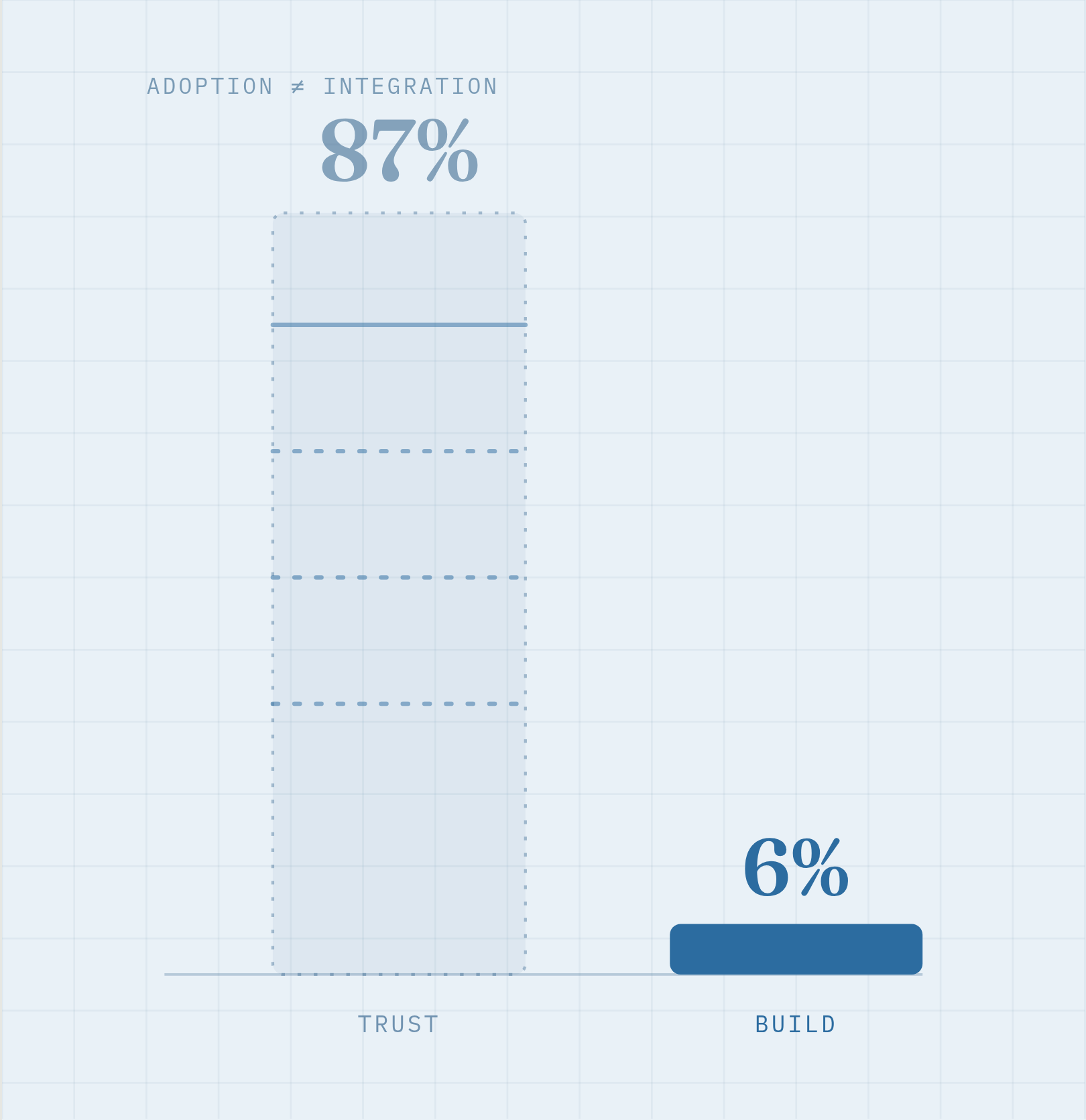
Nine in ten marketers now “use AI.” Six percent have actually built with it. That gap is the whole story.
I have a theory about the AI revolution in marketing, and it is slightly rude, so let me ease into it.
Everybody is “using AI.” Truly everybody. If you ask a room full of marketers in 2026 whether they use artificial intelligence in their work, roughly nine in ten hands go up, and the tenth person is lying to seem mysterious. Salesforce’s State of Marketing 2026 puts adoption at around 87 to 91% of marketers running generative AI in at least one workflow — a leap from 51% just two years earlier. HubSpot reports that 94% of marketers plan to use AI in content creation this year. The “should we adopt AI” debate is so thoroughly over that having it now marks you as someone who recently emerged from a cave.
And yet. Here is the number that I cannot stop thinking about, the one that exposes the entire glittering illusion. Supermetrics surveyed 435 marketers across the US, UK, Germany, Australia, and Singapore for its 2026 Marketing Data Report and found that while 80% of marketers feel pressure to adopt AI, only 6% have actually embedded it into their workflows. Six. Percent.
| 6%of marketers have truly embedded AI into their workflows — while 80% feel pressure to adopt it.SUPERMETRICS · 2026 MARKETING DATA REPORT |
So let me state my rude theory plainly: we have all enthusiastically learned to trust AI, and almost none of us have learned to build with it. We have adopted the verb and skipped the noun. We typed a few prompts, got a usable email draft in nine seconds, felt the dopamine, declared ourselves transformed, and then went right back to doing everything else exactly the way we did it in 2022. The revolution, for most teams, is a very expensive way to write faster first drafts.
Adoption is not integration, and the gap is the whole story
The thing nobody wants to say at the conference is that “using AI” and “having built something with AI” are wildly different achievements, and the marketing world has quietly conflated them to feel further along than it is.
The evidence of the gap is everywhere once you look. Only about 23 to 34% of companies have AI agents actually integrated into their marketing stack in production, according to multiple 2026 surveys; the rest are running AI in disconnected little silos — a writing tool here, an image generator there, none of them sharing context, maintaining brand voice, or compounding in value. Supermetrics found that 52% of marketers do not even own their data strategy — it lives with IT or data engineering — which means the people expected to make AI sing do not control the instrument. And only about a third say they can activate their data effectively at all.
This is the quiet scandal of the AI revolution: you cannot bolt a brilliant generative engine onto a broken data foundation and expect magic. As the Supermetrics report put it almost cruelly, AI can generate a thousand content variations, but it cannot fix fragmented infrastructure. Feed a genius model a swamp of disconnected, half-consented, contradictory customer data and it will produce confident, fluent, beautifully-worded nonsense at scale. We did not buy a revolution. Most of us bought a very articulate intern and gave it no access to the filing cabinet.
We did not buy a revolution. Most of us bought a very articulate intern and gave it no access to the filing cabinet.
I find a grim comedy in the tooling numbers too. The number of available AI marketing tools exploded from about 1,200 in 2024 to over 3,800 in 2026. Median monthly AI tool spend at mid-market teams nearly tripled, from roughly $1,200 to $3,400. We are buying tools faster than we are learning to use the last one. This is not building. This is hoarding, with a SaaS subscription attached.
The part where the customers noticed
Now for my favourite uncomfortable data point, because it punctures the second great illusion: that customers are as delighted by all this as we are.
They are not. Consumer comfort with brands using AI fell from 57% to 46% in a single year — an eleven-point drop while adoption was accelerating. Roughly half of consumers say they can now correctly identify AI-written content, and around 52% say they disengage the moment they suspect copy was machine-generated. Over half are uncomfortable with AI virtual brand ambassadors replacing human faces. The discomfort is sharpest, predictably, wherever AI replaces something visibly, recognisably human.
| −11ptsConsumer comfort with brands using AI dropped from 57% to 46% in a single year — as adoption accelerated.CONSUMER SENTIMENT, 2026 |
The platforms noticed too, and they are less polite about it than your customers. Meta, TikTok, and Google all quietly began down-ranking obviously AI-generated creative in their 2026 ranking updates. So the very automation everyone rushed to adopt to “create content at scale” is now being penalised at scale by the algorithms it was meant to please. There is a beautiful, circular foolishness to it: marketers used AI to flood the channels, the channels got flooded, the channels learned to recognise the flood, and now the flood gets suppressed. We automated our way into a new problem and called it innovation.
Where AI genuinely earns its keep (so I’m not just being cynical)
I do not want to be the person at the party insisting the wonderful new thing is fake. The wonderful new thing is real — when it is built into something, not sprinkled on top.
The ROI data, read carefully, tells a precise and useful story. AI content drafting delivers around 3.2x ROI on average. Personalization engines deliver around 2.7x. These are the use cases where AI compresses an existing, well-understood workflow — it makes a thing you already do faster and cheaper. Meanwhile, AI video sits at a limp 1.1 to 1.6x, and AI-generated paid social creative underperforms outright. The pattern is unmissable: AI pays where it accelerates a workflow you have already built, and disappoints where you expected it to invent a new one for you.
| 3.2×ROI from AI content drafting — strongest where AI accelerates a workflow you already built, not where it invents one.AGGREGATE ROI BENCHMARKS, 2026 |
That is the whole secret, and it is unglamorous. The teams seeing real returns — that elusive 6% — did not find a better prompt. They did the boring work first: they connected their data, defined who owns what, decided specifically where AI fits and what decision it serves, and only then let the model loose on a foundation worth standing on. McKinsey’s data backs this with a line I repeat constantly: human-AI collaboration consistently beats full automation. The strongest results come not from handing the keys to the robot, but from a competent human steering a powerful tool across solid ground.
The productivity mirage
There is a softer version of the trust-without-building problem, and it fools even smart teams, so let me drag it into the light.
The headline productivity numbers are genuinely lovely. HubSpot reports the average marketer now recovers around 6.1 hours per week thanks to AI, with senior people saving eight to ten. McKinsey-adjacent figures float a roughly 41% revenue uplift and a 32% reduction in customer-acquisition costs for organisations that implement AI in marketing well. Read quickly, those numbers suggest a revolution has already happened and we all simply forgot to notice the confetti.
But sit with the phrasing — when implemented well, on average — and the mirage shimmers. Those gains accrue to teams that built AI into a workflow, not to teams that merely opened a chatbot tab. The six recovered hours are only a gift if they get reinvested into higher-value work; in plenty of teams they quietly evaporate into producing more mediocre content faster, which the platforms then down-rank, which produces nothing but a larger pile of ignored material at greater speed. Velocity without judgment is not productivity. It is just being wrong more efficiently, with a subscription.
Velocity without judgment is not productivity. It is just being wrong more efficiently, with a subscription.
Then there is the agent theatre. Surveys this year cheerfully report that around 90% of marketing teams use AI agents to expedite decisions — a headline that sounds like the future has fully arrived. Read on and you find that only about 34% of enterprise teams actually run autonomous agents in production; the other half pilot endlessly and never deploy. Gartner expects that over 40% of agentic AI projects are at risk of cancellation by 2027 without proper governance and ROI tracking, and the most-cited blocker is, predictably, poor data quality. Which returns us, as everything does, to the same unglamorous truth: the model was never the bottleneck. The foundation was. We keep buying smarter engines and bolting them to the same cracked chassis, then act surprised when the ride is bumpy.
Governance: the part nobody wants and everybody needs
Here is the least exciting sentence I will write all year, and possibly the most important: governance lags adoption, and that lag is where the disasters live.
Roughly three-quarters of organisations now use generative AI in at least one function, but only about a third have meaningfully redesigned their processes — including the boring, vital scaffolding of policy, oversight, and risk control — around it. That mismatch is how you get the AI-generated email that quotes a discount you never offered, the chatbot that confidently invents a return policy, the campaign that personalises its way straight into a privacy complaint. Each of these is not a model failure. It is a building failure — an absence of the human guardrails that turn a powerful, unpredictable tool into a dependable system.
The 6% who built something real did not skip this part because it was tedious. They did the tedious part because it was the moat. Anyone can license a model. Almost nobody is willing to do the patient governance work that makes the model safe to trust at scale — which is precisely why doing it is worth so much.
“We trust but we don’t build” — what that actually costs
So why does the trust-without-building pattern persist, when the fix is well known? Because building is hard and trusting is easy, and humans, including marketers, will choose easy every single time we are allowed to.
Trusting AI takes an afternoon: open the tool, marvel at the output, feel modern. Building with AI takes a quarter of unglamorous plumbing: untangling your customer data, deciding governance, writing the policies, training the team, integrating the systems, and resisting the urge to buy the 3,801st tool instead of mastering the three you have. One of these produces a satisfying story to tell your board. The other produces actual compounding advantage. Guess which one most teams choose.
And the cost of choosing easy is not zero — it is widening. The 6% who built something real are not 6% better off; they are structurally ahead in a way the rest cannot casually catch up to, because their advantage compounds. Their AI knows their brand voice, their customer history, their context, and it gets smarter every week. The other 94% are still re-briefing a stateless chatbot every morning like it is the first day of a job it will never remember having. Salesforce found enterprise adoption is basically saturated; the growth now is mid-market teams finally moving from “using” to “integrating.” The window where merely adopting AI was impressive has closed. The bar is now building, and most of the industry is standing under it congratulating itself for showing up.
What I tell clients, with love and a little exasperation
When a client tells me proudly that they have “rolled out AI across the marketing team,” I have learned to ask one gently deflating question: built into what? Usually the answer is a thoughtful silence, which is fine, because the silence is where the real work starts.
Here is the honest counsel. Stop measuring your AI maturity by how many tools you have licensed and start measuring it by how many of your actual workflows it is genuinely embedded in — not assisting from the sidelines, embedded. Fix the data foundation before you fall in love with the model; a brilliant engine on a broken chassis is just an expensive noise. Own your data strategy instead of outsourcing it to a team that, very reasonably, optimises for storage cost rather than marketing usefulness. Choose the two or three workflows where AI accelerates something you already do well — drafting, personalization, analysis — and go genuinely deep, rather than spreading a thin, shiny layer of automation over everything and calling it transformation. And for the love of all that is holy, keep a human in the loop, because your customers can smell the machine from across the room and roughly half of them will quietly walk away when they do.
The revolution is real. It is just not where most of us are looking. It is not in the adopting, the prompting, the breathless LinkedIn post about how AI “changed everything.” It is in the quiet, patient, deeply unsexy act of building — and the marketers who skip that part to enjoy the trusting part are about to learn, the expensive way, that the two are not the same thing at all.
We trust. We don’t build. The 6% who do both are going to spend the next three years politely eating our lunch, and I, for one, intend to be sitting at their table. ■