In an age defined by rapid conceptual innovation, abstract systems are often developed to explain processes that blend structure, adaptability, and long-term sustainability. Among these emerging constructs, one framework has gained attention for its layered logic and practical symbolism. This article explores the idea in depth, focusing on how immorpos35.3 works as a complete model rather than a single mechanism. The discussion unfolds gradually, allowing the reader to understand its background, principles, internal dynamics, and broader implications without relying on technical jargon or external references.
At its core, the framework represents an attempt to explain transformation without chaos. It acknowledges that systems—whether social, organizational, or conceptual—do not change in isolation. Instead, they evolve through interdependent stages that preserve essential identity while permitting meaningful growth. By examining how immorpos35.3 works, one can better appreciate why it has been described as both stable and flexible, a balance that many modern systems struggle to achieve.
Origins and Conceptual Foundations
Every framework begins with a question. In this case, the question centered on how systems could adapt continuously without losing coherence. Traditional models often forced a choice between rigidity and volatility. The creators of this framework proposed an alternative: a layered structure that integrates memory, responsiveness, and controlled transformation. Understanding how immorpos35.3 works requires seeing it as a response to the limitations of earlier approaches.
The foundational idea is simple yet profound. Change is inevitable, but it can be guided. Instead of resisting transformation or embracing it blindly, the framework proposes a measured path where each adjustment is evaluated in context. This philosophy resonates strongly in environments where long-term continuity matters as much as short-term performance.
Structural Layers and Their Roles
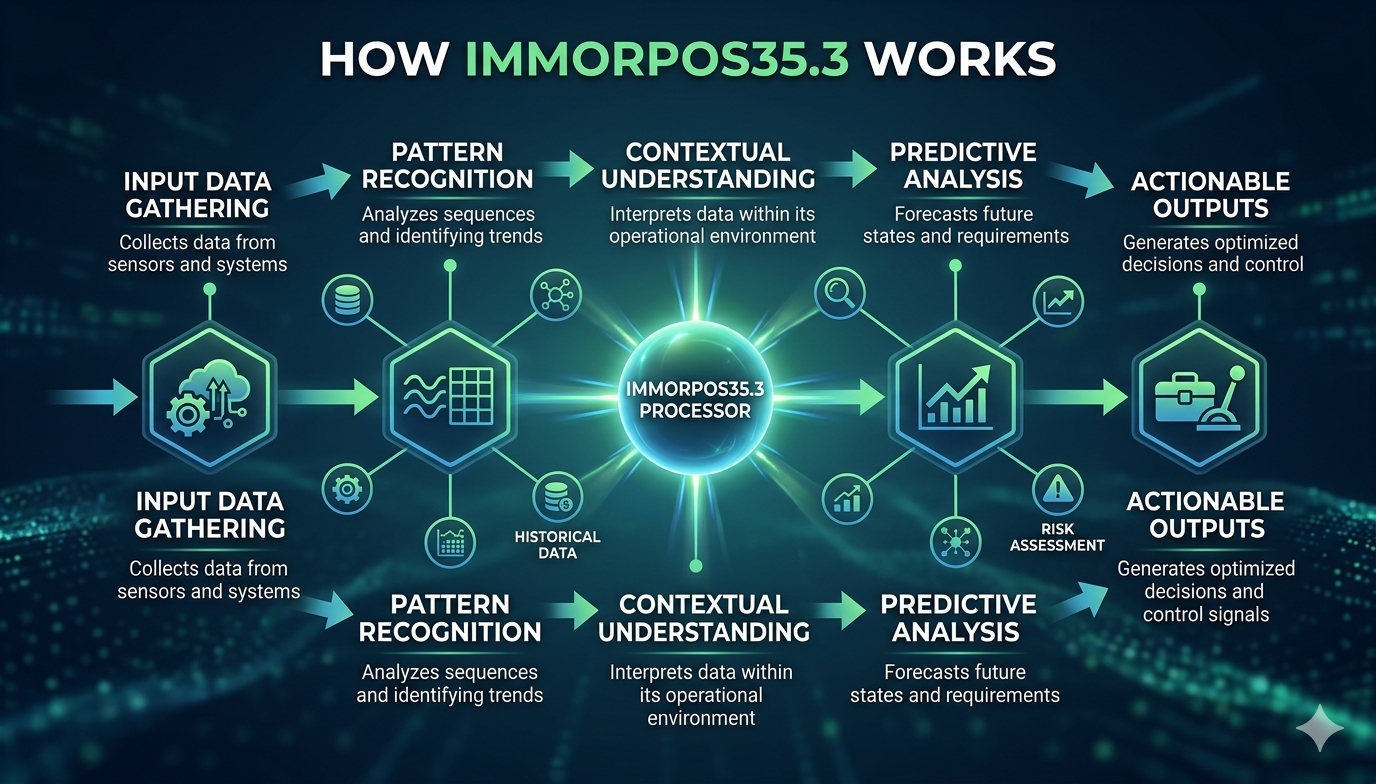
One of the most distinctive aspects of the framework is its layered design. Each layer serves a specific purpose, contributing to overall resilience. When people ask how immorpos35.3 works, they are often referring to this internal architecture.
The first layer focuses on core identity. It defines the non-negotiable elements that must remain intact regardless of external pressure. The second layer manages adaptation, translating environmental signals into incremental changes. The third layer evaluates outcomes, ensuring that adjustments align with overarching goals. Together, these layers form a feedback loop that supports evolution without fragmentation.
Dynamic Feedback and Learning
A critical feature of the framework is its emphasis on feedback. Rather than treating outcomes as final, it views them as data points for future decisions. This continuous learning process is central to understanding how immorpos35.3 works in practice.
Feedback is gathered through observation, measurement, and reflection. Each cycle of feedback refines the system’s responses, making it more adept over time. Importantly, learning is not confined to success; failures are treated as valuable sources of insight. This perspective encourages experimentation within safe boundaries, fostering innovation while minimizing risk.
Adaptability Without Instability
Adaptability is often associated with unpredictability. However, the framework challenges this assumption by demonstrating that flexibility can coexist with order. Observers studying how immorpos35.3 works often highlight its ability to absorb shocks without collapsing.
This resilience stems from predefined thresholds. Changes are permitted only within ranges that preserve system integrity. When external forces push beyond these limits, the framework prioritizes stabilization before further adaptation. This mechanism ensures that growth does not come at the expense of coherence.

Ethical and Philosophical Dimensions
Beyond mechanics, the framework carries ethical implications. It suggests that responsible transformation requires awareness of consequences and respect for foundational values. Discussions about how immorpos35.3 works frequently touch on its moral neutrality paired with ethical applicability.
By embedding evaluation into every stage, the framework discourages reckless change. Decisions are weighed not only for efficiency but also for alignment with core principles. This approach has made the concept appealing in discussions about governance, education, and long-term planning. why upgrade immorpos35.3 software regularly
Practical Applications Across Contexts
Although abstract, the framework lends itself to practical interpretation. Organizations have used its principles to redesign workflows, while communities have applied them to social development strategies. In each case, understanding how immorpos35.3 works provides a roadmap for gradual, sustainable progress.
For example, an organization undergoing restructuring might use the layered model to identify which cultural elements must remain unchanged while updating operational practices. Similarly, community initiatives can adapt policies incrementally, learning from each phase rather than implementing sweeping reforms.
Comparative Perspective
When compared to linear or cyclical models, the framework stands out for its integrative nature. Linear models often assume predictable progression, while cyclical ones emphasize repetition. By contrast, the approach examined here combines progression with reflection. Analysts exploring how immorpos35.3 works note that it neither repeats blindly nor advances without reference to the past.
This hybrid quality allows it to operate effectively in complex environments. It acknowledges history without being constrained by it, and it embraces the future without disregarding present realities.
Cultural and Global Relevance
Although developed within a specific intellectual tradition, the framework has found resonance across cultures. Its emphasis on balance and continuity aligns with diverse philosophical perspectives. Interestingly, discussions in the United States have highlighted its relevance to debates about sustainable innovation and institutional reform.
The framework’s adaptability makes it culturally portable. Rather than prescribing fixed solutions, it offers a method for developing context-specific responses. This universality has contributed to its growing influence in global conversations about change management.
Challenges and Misinterpretations
No framework is immune to misunderstanding. Some critics argue that its emphasis on gradual change may slow urgent action. Others misinterpret its flexibility as indecision. Addressing these critiques requires a clear explanation of how immorpos35.3 works and why its design choices are intentional.
The framework does not deny the need for decisive action. Instead, it encourages decisions that are informed by feedback and aligned with core values. When urgency demands rapid response, the model’s thresholds can be adjusted temporarily, provided that stabilization mechanisms remain in place.
Long-Term Impact and Evolution
Ironically, a framework built around adaptation must itself evolve. Its designers anticipated this by allowing for meta-reflection—periodic reassessment of the framework’s own assumptions. This self-referential quality is another reason why understanding how immorpos35.3 works requires patience and depth.
Over time, new layers can be added, and existing ones refined. This ensures that the framework remains relevant as contexts change. Rather than becoming obsolete, it grows alongside the systems it guides.
Educational Value and Learning Models
Educators have also found value in the framework as a teaching tool. By illustrating structured adaptation, it helps learners grasp complex concepts about systems thinking. Lessons built around how immorpos35.3 works often emphasize critical thinking, reflection, and iterative improvement.
Students are encouraged to view knowledge as evolving rather than static. This mindset prepares them for environments where learning does not end with formal education but continues throughout life.
Synthesis and Reflection
Bringing these threads together reveals a coherent picture. The framework is not a rigid formula but a living model. Its strength lies in its ability to balance continuity with change, ethics with efficiency, and structure with flexibility. Each exploration of how immorpos35.3 works uncovers another layer of meaning, reinforcing the idea that understanding deepens through engagement.
By resisting extremes and embracing measured transformation, the framework offers a compelling response to the challenges of complexity. It invites users to think systemically, act responsibly, and learn continuously.
Conclusion
In a world where change is constant and often overwhelming, frameworks that offer guidance without constraint are invaluable. The model discussed here provides such guidance through its layered structure, feedback-driven learning, and ethical awareness. Ultimately, understanding how immorpos35.3 works is less about mastering a set of rules and more about adopting a mindset—one that values balance, reflection, and purposeful evolution.
As individuals and organizations seek sustainable paths forward, the principles embodied in this framework remain relevant. They remind us that progress does not require abandoning identity, and that thoughtful adaptation can lead to resilience and long-term success.